Hornets: Gentle Giants!
Bad press - what is true?
Hornets are peaceful animals!
Responsible Publisher
Dieter Kosmeier
Photo Galleries and Videos
Dr. Elmar Billig
Scientific Advisor
Thomas Rickinger
Translation
Kevin Foster
|
The lifecycle of hornets over the
year - a first overview:
Note:
The exact dates for the described events
usually vary to some extend from colony to colony, depending on weather
conditions, region, climate, and so on
...
- April, 25th - hornetqueen leaves her
winter hideout
- May, 10th - she settles in a nesting
box and begins to build a nest
- May, 14th - she puts her first egg
down
- May, 24th - hatch out of the first
larva
- June, 7th - the first larva begins
its metamorphosis
- June, 12th - hornetqueen is attacked
by an usurper
- June, 21st - eclosion of the first
worker
- June, 23d - first flight of the first
worker
- June, 29th - second attack by an
usurper - hornetqueen has now got 4 workers with her, who kill the invader
- July, 22d - a bird nesting box is now
too small for the hornetnest (that consist of 4 combs with about 180
workers). Workers start to fly out for searching a new place for the nest.
- July, 26th - beginning of the
building of a new nest in a new place. This process is called relocation.
- August, 5th - the queen begins to put
eggs down, witch will become males and females (young queens)
1)
- August, 14th - description of the
"royal court" behavior
- August, 15th - eclosion of the first
adult males
- August, 31st - eclosion of the first
queen-larvae
- October, 8th - hornetqueen begins to
be neglected by workers and suffers from malnutrition
2)
- October, 15th - death of the founder
queen
- October, 16th - mating ; beginning of
the hibernation of the young queens
3)
- November, 5th. The last worker of the
colony dies during a frosty autumn night
4)
1) Rearing of males starts earlier than
queens, usually by the end of July or the first
week of August.
2) The demise of the old queen already begins with the eclosion of the
first gynes in mid-September.
3) Mating flights take place on sunny days from mid-September
to the end of October.
The young gynes seek hibernation quarters
immediately after mating.
4) Depending on the climatic conditions during the autumn this event may
take place several weeks
earlier, e.g. in northern
Germany.
|
...listen to them here!
click
on thumbnails to enlarge the images
The majority of people
consider hornets highly dangerous and their presence often causes fear and panic. This arises due to exaggerated stories of hornets attacks and the effect of their stings.
"Seven hornet-stings kill a horse, three an adult and two a child ". Such neighbourhood myths, held for generations, have led to the hornet becoming quite rare in
many area of Germany, due to merciless human pursuit. Indeed in many regions of Central Europe, the hornet is threatened with extinction!
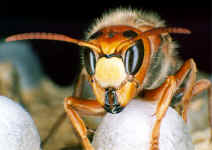
Hornet
(Vespa crabro, Linnaeus 1758) with their aposematic (warning) yellow-black colouring. Shown are their large, highly sensitive main eyes.
These are supported by three ‘simple’ eyes, so called "Ocelli", which are thought to be horizon detectors,
arranged in a triangle (see the right picture)
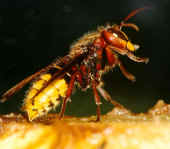
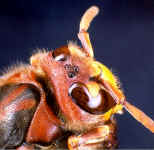
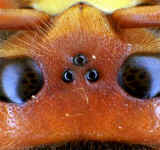
Description
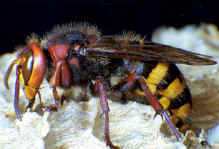
The largest European wasp; the female measures 25 to 35 mm long, males
and workers are smaller. In males, the antennae have 13 segments, while females have 12. The male abdomen is composed of 7 visible segments, while that of the
female has 6; females are equipped with an ovipositor. Eyes are deeply indented, shaped like a C. Wings are reddish-orange, the petiolated abdomen is orange
striped with brown.
Hornets belong to the order or group Hymenoptera. They are closely related to ants and
bees, which are also in the same order. Hymenoptera means joined wings or married wings; Hymen = god of marriage, ptera =
wings. The hind wings join to the fore wings with a row of tiny hooks (called hamuli).
Like most nest building insects, hornets will defend their colony when they consider it threatened. Therefore, the
behaviour of hornets must be roughly divided into two catagories:
-
That in close
vicinity to the nest (radius by 2-3m)
-
That outside of the nest area.
In the presence
of a hornet, four things should be avoided: rapid movements, blocking the flight path, vibrating or breathing on the nests.
With care and calm it is quite possible to study the intimate life of hornets without being stung.
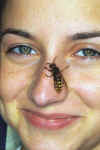 |
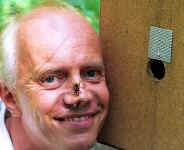
Outside of the nest area hornets never attack groundlessly. Few people realise that hornets are amazingly peaceful
animals, even shier than honey bees, which prefer to evade conflict. Scientifically it has been
shown that stings of hornets are not more dangerous than bees and wasps. It is
their considerable size (queen to 35mm) and loud flight noises that induce unnecessary
fears. Those striking out in fear are those that may be stung. |
 |
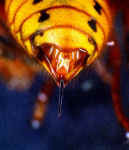
For most people a hornet sting
represents no special danger. Hornet poison is not more toxic than bee or wasp poison!
Some scientific results: Bee poison is chemically and toxically very well
investigated, since it is easy to obtain. LD50, the poison component that leads to 50% of cases of death
in lab mice, amounts to 6mg poison per kg body weight for bee poison. Reports for hornet poison range from 10mg/kg (HABERMANN 1974) to 90mg/kg (KULIKE 1986), around 1.7 – 15
weaker than honeybees!
(Sources of the scientific results Kulike / Habermann)
 |
Unlike bees, the poison of wasps and hornets is not intended for use against vertebrates (like us) alone. Bees are nectar
collecting animals, but wasps and hornets are hunters of insect prey. With several kilograms of honey in an average bees nest, the primary role of the bee sting is to defend
the colony against sweet-toothed attackers, ranging from the mouse through badgers to brown bears and humans.
|
 |
Wasps have substantially fewer such natural enemies. |
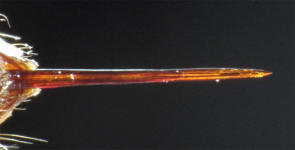
This explains the autotomous sting of the honey bee, a bee will lose its sting and its life stinging a
vertebrate. What it gains is the injection of additional poison from the poison gland
which continues to pump on its release. Wasps and hornets use their sting to kill troublesome insect prey. They cannot afford to be
wasteful, as they need to be able to sting repeatedly, injecting just about 0.16 - 0,19 mg
poison (oven-dry mass). We, hence, have more to fear in the sting of the bee than the hornet!
However, the hornet sting contains 5% acetylcholine which stimulate pain fibres more than stings of
other wasps and bees. So the sting of a hornet may be a little bit more painful.
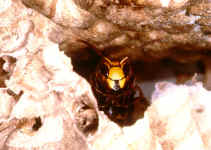
Guard at the nest entrance
 |
Sting advice: cooling the area is soothing, as for bee stings. In exceptional cases hornet
stings, like other insect stings, can induce an allergic reaction, arising from an overactive immune system. These reactions begin with
considerable swelling and redness in the affected area. In the case of a reaction you should see a doctor to be on the safe side. |
The hornet lives throughout most of Europe, but is never found north of the 63rd parallel. It is also found in Asia, the United States
and Canada. Meanwhile also in Guatemala.
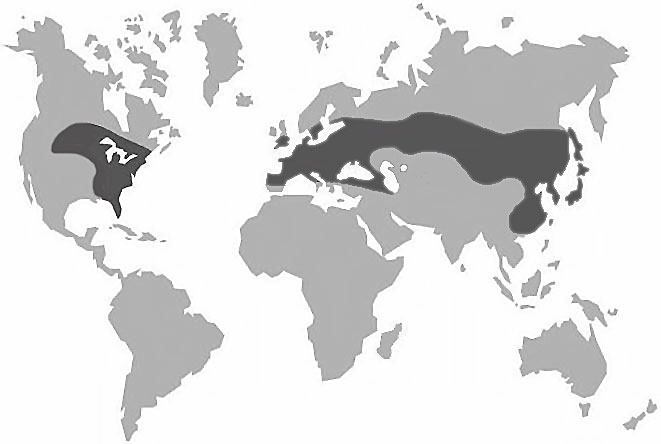
There are several
geographic color forms of the Hornet found worldwide:
Sources:
J. Bequaert. The color forms of the common hornet, Vespa crabro Linnaeus.
Konowia (1931) 10, 101-109.
V. Dubatolov, J. Kojima, J. M. Carpenter, A. Lvovsky. Subspecies of Vespa crabro
in two different papers by Birula in 1925. Entomological Science (2003) 6,
215-216
J.M. Carpenter, J. Kojima. Checklist of the species in the subfamily Vespinae (Insecta:
Hymenoptera: Vespidae). Natural History Bulletin of Ibaraki University 1 (1997),
51-92.
-
Vespa crabro crabro Linnaeus, 1758
-
Vespa crabro vexator Harris, 1776
-
Vespa crabro germana Christ, 1791
-
Vespa crabro crabroniformis Smith, 1852
-
Vespa crabro oberthuri du Buysson, 1902
-
Vespa crabro flavofasciata Cameron, 1903
-
Vespa crabro altaica P�rez, 1910
-
Vespa crabro caspica P�rez, 1910
-
Vespa crabro chinensis Birula, 1925
Technically, Vespa crabro is the only hornet in North America, but it did not originate here; it
was introduced from Europe. The European hornet was first reported in North America about 1840 in New York state. Since then, it has spread to most of the
eastern United States, reaching as far west as Louisiana and the Dakotas.
Nowadays it is found in the northeastern quarter of the United States; ranging from Canada, Ontario, North Carolina, Texas, Tennessee and south through the eastern and central
US, with scattered sightings extending west of the Mississippi River.
The European hornet "Vespa crabro"
is the largest vespine in North America. It is the only vespine in the new world that is brown with yellow markings. The vertex of the Vespa crabro is much larger
than wasps of the genera Vespula and Dolichovespula.
 |
Even though Vespa crabro is rarer than the various
species of Vespula and Dolichovespula, it is not in danger of extinction in the
USA. It seems to be doing well in its range there. Generally, it is considered
to be a forest species in the USA. This means that it is rare to find a Vespa
crabro colony near human habitats (unless it is out in the country). So, human
contact with colonies of this particular species is uncommon in the USA. Though
it does happen on occasion. However, few reactions to stings have been reported
there. |
Common names for Hornets in other countries:
 |
USA: Giant Hornet, European
Hornet, Old World Hornet. Vespa crabro is there also commonly called the "Brown Hornet", and is sometimes
mistakenly referred to as the "Japanese Hornet". This is the largest and, technically, the only true hornet found in the United States. It is not the
same wasp as the "Bald-Faced-Hornet" or the "Yellow Hornet". |
Next page:
Life cycles of a hornet colony

Hymenoptera>Vespoidea>Vespidae>Vespa crabro>Hornisse>Hornet>Frelon>Hoornaar>Vespa grande>Abejorro>Calabrone
Hymenoptera>Vespoidea>Vespidae>Vespa crabro>Hornisse>Hornet>Frelon>Hoornaar>Vespa grande>Abejorro>Calabrone
Webmaster:
Dieter Kosmeier
Hymenoptera>Vespoidea>Vespidae>Vespa crabro>Hornisse>Hornet>Frelon>Hoornaar>Vespa grande>Abejorro>Calabrone
Hymenoptera>Vespoidea>Vespidae>Vespa crabro>Hornisse>Hornet>Frelon>Hoornaar>Vespa grande>Abejorro>Calabrone

www.hornissenschutz.de
www.vespa-crabro.de
|


